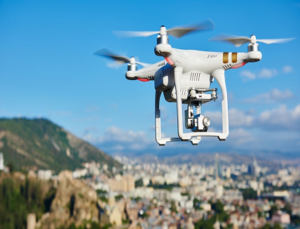
Drone technology encompasses the design, development, and application of unmanned aerial vehicles (UAVs), also known as drones. These versatile machines are equipped
Warning: Undefined variable $thumb in
/home/fabrotics/public_html/blog-details.php on line
326
Components of a Drone:
Frame/Body: Provides the structure for the drone and houses its components.
Motors and Propellers: Generate thrust for flight.
Flight Controller: A sophisticated computer that processes sensor data and controls the drone's movements (speed, altitude, direction).
Sensors: Drones utilize various sensors like accelerometers, gyroscopes, magnetometers, barometers, GPS, and sometimes radar or lidar for navigation, obstacle avoidance, and data collection.
Cameras and Other Sensors: Drones can be equipped with RGB cameras, thermal cameras, and other sensors (like multispectral or hyperspectral) for capturing images and data.
Battery: Provides power for the drone's operation.
Remote Control/Transmitter: Allows for remote control and data transmission.
2. Types of Drones:
Multirotors: Most common type, using multiple rotors for lift and maneuverability, including quadcopters, hexacopters, and octocopters.
Fixed-wing: Resemble airplanes, offering longer flight times and range.
Single-rotor: Similar to helicopters, offering stability and longer flight distances.
Hybrid VTOL: Combine characteristics of fixed-wing and multirotor drones.
3. Key Technologies:
GPS and Inertial Measurement Units (IMUs):
Provide precise navigation and positioning. IMUs combine data from accelerometers, gyroscopes, and magnetometers.
Obstacle Avoidance Systems:
Use sensors like ultrasonic, laser, or lidar to detect and avoid obstacles.
Artificial Intelligence (AI) and Machine Learning:
Enable drones to perform complex tasks autonomously, such as image analysis, pattern recognition, and decision-making.
Sensor Fusion:
Combining data from multiple sensors to improve accuracy and reliability.
4. Applications:
Photography and Videography: Capturing stunning aerial footage for various purposes.
Agriculture: Monitoring crop health, spraying pesticides, and assessing yield.
Infrastructure Inspection: Inspecting bridges, power lines, and other infrastructure with greater efficiency and safety.
Search and Rescue: Locating lost individuals and providing assistance in disaster zones.
Delivery Services: Delivering packages and other goods.
Security and Surveillance: Monitoring perimeters, detecting suspicious activity, and providing situational awareness.
Military Applications: Reconnaissance, surveillance, and targeted strikes.
5. Future Trends:
Increased Autonomy:
Drones will become more capable of performing complex tasks without human intervention.
Advanced AI and Machine Learning:
AI will play an even greater role in drone operations, enabling them to adapt to changing environments and make more intelligent decisions.
Longer Flight Times and Range:
Advances in battery technology and drone design will lead to drones that can fly for longer periods and cover greater distances.
Integration with other technologies:
Drones will be increasingly integrated with other technologies, such as 5G networks and the Internet of Things (IoT), to create more powerful and interconnected systems.
This video discusses the applications of drone technology in various industries:
← Back to Blogs